or
War as a Possibility: The Four Sins of Foreign Policy in Times of Conflict and in Times of Peace
"Si vis pacem, para bellum.”
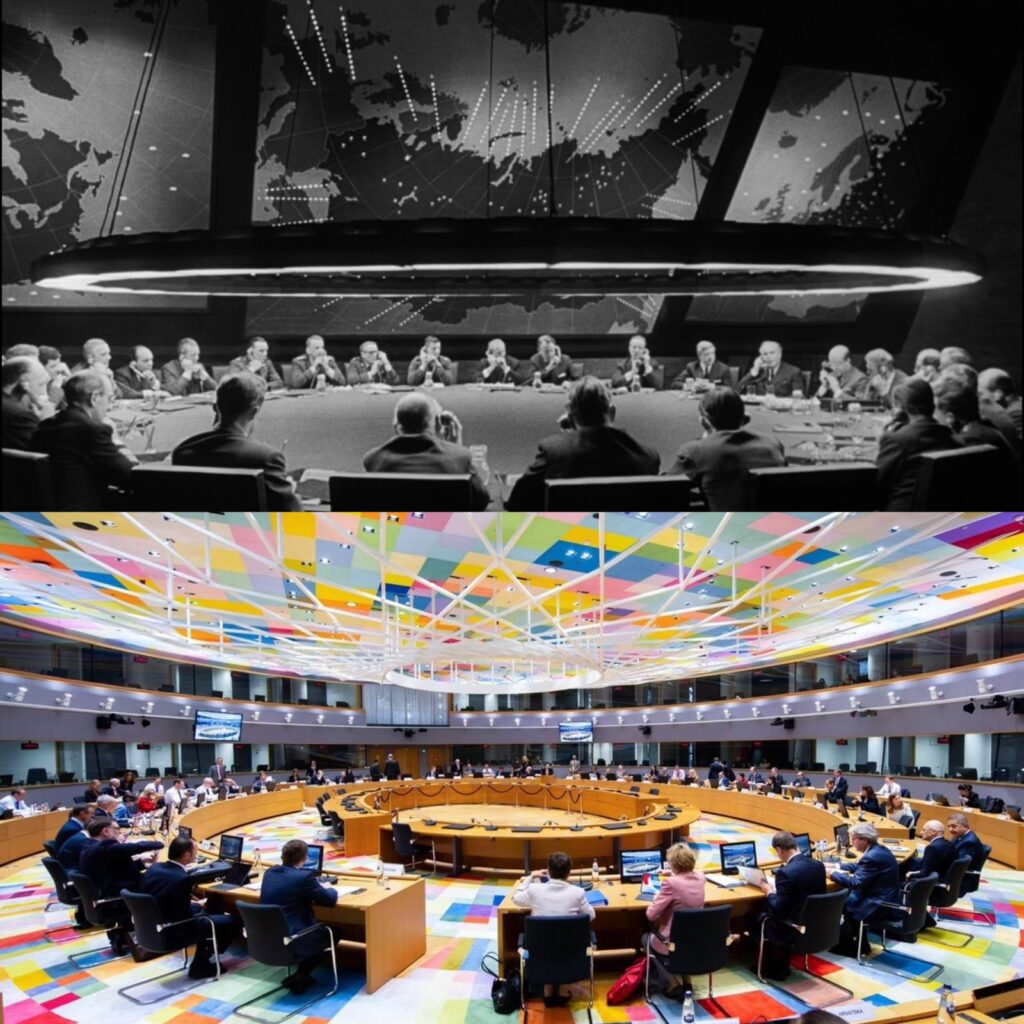
On February 28, 2026, the U.S. and Israel, in a joint operation, attacked Iran and killed Supreme Leader Ali Khamenei (Y. S.). Iran retaliated by attacking multiple European and American military bases in the region. As tensions escalated, countries such as France and the U.K. began preparing for war, considering it as a serious possibility.
This preparation represents a dramatic shift in how European countries, NATO, and the EU perceive war. This shift was first initiated in February 2022, as Russia invaded Ukraine. Since then, and now, due to the conflict in the Middle East, Europe is being forced to confront a reality it spent decades trying to forget: war.
For most of the post-World-War-II period, especially since the end of the Cold War, Europe did not consider war as a real possibility, believing the barbaric days of war were over. This perception stems largely from—and is explained by—the trauma of World War II and the destruction it caused to infrastructure, values such as democracy and freedom, and the staggering human cost. At that point, especially for European countries, war stopped being perceived as an imminent threat, becoming a historical trauma.
After the war—since the establishment of EU’s earliest predecessor, the European Coal and Steel Community (ECSC)—, the institutionalist and internationalist thought dominated the European states and, as it was founded, the institutions of the European Union. The Schuman Declaration, from 1950, makes this trend evident, stating that "The solidarity in production thus established will make it plain that any war between France and Germany becomes not merely unthinkable, but materially impossible."
The Declaration is not a mere point of view of what is, now, the EU’s policy regarding international conflicts. It is the blueprint of its view on the possibility of war. Besides not even imagining external threats to the EU, solely focusing on the tensions between European countries, this policy of considering war impossible persists to this day. Frederica Mogherini stated, in 2016, sixty-six years after the Schuman Declaration, that "Today, we cannot even imagine war inside our continent." This was stated two years after Russia annexed Crimea and a mere twenty-one years after the full-blown war between the countries that previously constituted Yugoslavia. If the recent past is not enough to dismiss Mogherini’s claim as wishful thinking, the present certainly is, with Europe now facing clear and obvious security risks stemming from multiple current and external conflicts.
Such a high level of complacency can only emerge in a culture in which no space is left, not even for a single ounce of realism.
Josep Borrell, unlike his predecessor, Mogherini, had the intellectual courage, autonomy, and independence to assert that "the EU needs to learn to speak the language of power" and that security and defense are "THE European issue[s]".
This warning exists within a realist tradition of international thought. To consider war as a serious, possible, and valid line of action is not the position of a warmonger. It is the only reasonable position of a realist who does not want war. It is the best way to avoid the unnecessary escalation of conflicts, making peace more plausible. The problem was never the noble desire for peace. The problem was—and continues to be—believing that peace is a reality independent from the reality of war and obtainable without power.
There are four distinct main ways through which states neglect the reality of war: (i) Neglecting investments in defense, (ii) Believing war has become impossible, (iii) Over-relying on international institutions and law, and (iv) Removing war from the range of acceptable options.
History offers many examples of states that neglected war through these four ways: Denmark through lack of military investment and preparation; Qing China through complacency; Ethiopia by placing its fate in the hands of international law; and Britain through the refusal to confront the reality of aggression.
On April 9, 1940, Germany launched Operation Weserübung, invading Denmark and Norway simultaneously. The Danish army was small, poorly equipped and strategically unprepared for a large-scale invasion, perfectly illustrating the first of the mistakes previously identified: neglecting investments in defense.
German troops crossed the border in the early hours of the morning while paratroopers seized key airfields and infrastructure.
The Danish, unlike leaders in situations that will be explored, did not refuse to believe in the likelihood of war, did not over-rely on international law and international institutions, and did not dismiss war as a tool of diplomacy. Their mistake was fatalistically believing that, in the event of war, Denmark would not have a chance of winning, regardless of any possible preparations and investments in defense.
When the Germans invaded, the only choice Denmark was left with was to surrender, which it did after only six hours. What followed was a country occupied by Nazi forces for five years.
Assuming such a position is to renounce the power that a state might have otherwise had to prevent war. The case of Denmark shows that it is only through power that serious and effective negotiations can take place and result in peace. “The power to hurt is bargaining power”, as argued by Thomas Schelling. Deterrence requires a credible capability of resorting to war.
Moving on to point (ii), nineteenth century China, under the Qing Dynasty, is a classic example of strategic complacency.
Due to the belief of its centrality in the world and how its civilization was far more advanced than the others, China did not recognize the foreign threats posed by Europe. Europeans were not seen as strategic rivals or threats, but as distant commercial actors heavily dependent on Chinese markets. This perception delayed military modernization and prevented Chinese elites from recognizing the possibility of a technologically asymmetric conflict.
When Britain launched the First Opium War, in 1839, China faced an adversary whose naval and industrial capabilities it had drastically underestimated.
Regarding point (iii), the Second Italo-Ethiopian War (or the Second Italo-Abyssinian War) clearly exemplifies the mistake of over-reliance on international law and international institutions to prevent escalation of a conflict and to punish the infringements of international law.
In 1935, Mussolini’s Italy invaded Ethiopia. The country’s emperor, Haile Selassie, appealed to the League of Nations and, in 1936, personally addressed a special assembly convened to discuss the invasion.
Selassie asked the assembly not to recognize the Italian territorial conquests, as not to legitimize them. The proposal was met by a staggering twenty-three votes against, one in favor, and twenty-five abstentions.
The sanctions imposed on Italy were weak and short-lived, being lifted after only seven months. No significant military enforcement was given to Ethiopia.
In spite of the League of Nations’s principle of collective security, the interests of great-powers, like France and the U.K., were not aligned with Ethiopia’s. The aggressor prevailed and international law was simply not enforced. Legitimacy was not accompanied or paired with power to protect the victim.
For the last historical case, the immediate reaction of the U.K. regarding the rise of Adolf Hitler, in 1933—until England’s leadership under Chamberlain became unsustainable, leading up to the rise of Churchill—, is certainly one of the best examples of the mistake categorized by point (iv): Removing war from the range of acceptable options.
At first British newspapers and large segments of the public treated Hitler with the respect and reverence naturally given to any statesman. Hitler was respectfully referred to as “Herr Hitler", by the newspapers. Demonstrations gathered great numbers of people demanding that their country remained neutral and, some, that their country actually partnered with Germany, as to profit from trade agreements.
This same phenomenon was seen in the U.S., where the opposition to the idea of engagement in war, led by Charles Lindbergh, and made popular by news mogul William Randolph Hearst, either argued for neutrality or demanded that good diplomatic relations were established with Germany.
Neville Chamberlain, then Prime-Minister of England, opting for appeasement, went to the Munich Conference, on the September 30, 1938, to try and argue with Germany and solve all conflicts of interest through diplomacy.
Less than six months after the conference, on March 15, 1939, Czechoslovakia was invaded and less than six months after that, on September 1, 1939, Poland was invaded. A world war started less than a year after the great appeasement attempt that the Munich Conference was.
Regarding this failed attempt to avoid war, Churchill famously said: "You were given a choice between war and dishonor. You chose dishonor, and you will have war." Of course, honor and dishonor are not the best parameters for foreign policy strategy—just as hope is not a strategy. Churchill’s point, however, was deeper and more relevant than that. When war is excluded from the range of options and is not brought to the negotiations table, it often ends up happening anyway.
Statesmen, oftentimes, especially the ones leading great-powers, have to choose the lesser evil, as "The quest for peace requires the willingness to make painful choices." (Kissinger) To choose the catastrophe that will bring the least damage, destruction, and suffering to its people requires a statesman to have a noble degree of courage and a high level of historical perspective.
Regardless of how states may choose to ignore war, it remains part of the reality all countries exist in, whether it is recognized or not. In most cases, these mistakes, although separately explored, are superimposed in reality. A careful reader will certainly notice that the U.K.’s mistake, for example, can be categorized as over-reliance on international law, though it more clearly illustrates the mistake of not considering war as a valid possibility, since the U.K. did have a significant military arsenal and capability, but this capability was not accompanied by a disposition and psychological readiness for war.
Actions and omissions like these merely weaken the states and organizations led by idealists who believe, as the Secretary-General of the United Nations does, that "(...) there is no viable alternative to the peaceful settlement of international disputes, in full accordance with international law (...)".
These historical examples used are not mere curiosities of the past. They illustrate patterns of strategic behavior that continue to shape contemporary foreign policy debates, particularly in Europe.
The problem with the perception of war that was dominant in Britain during the 30s—and continues to be dominant throughout Europe today—is that it considers war as an immoral break of diplomacy. War, however, is a tool of diplomacy—and a necessary one. As Clausewitz put it, "war is a mere continuation of policy by other means." War needs to be considered both in times of peace—in order to maintain stability and prevent unnecessary escalation of international tensions—and in moments in which it should be the line of action taken to continue policy, when soft-power-diplomacy is not enough.
Living in peaceful times does not mean living in an idyllic world in which all states and peoples consider themselves brothers and sisters, living with great and deep respect for each other’s needs and cultures.
Clausewitz, with his most famous quote, was not celebrating the reality of war or advocating for it. He was outlining its nature and how it is not an immoral or evil alternative to diplomacy, but part of it.
The reality Europe is being forced to confront, as mentioned in the beginning of this article, breaks the EU’s prevalent narrative and policy regarding war. In a statement, Macron announced that France would increase its nuclear arsenal and would no longer publicly disclose its number of nuclear warheads.
This change, regardless of the feelings it may cause, represents the best and most plausible attempt to achieve peace. Peace requires that countries have and show unquestionable power.
The renewed attention to power and deterrence does not mean that war should be embraced or even frequently used. Though we have focused on situations in which conflicts of interest did in fact escalate to wars, a realist understanding of international relations recognizes that war is always a catastrophe and should be avoided in most cases, as it is unnecessary in most cases.
The reality of war never disappears. When war is removed from the table of strategic possibilities—from the minds of world leaders and from public discourse—, it does not become less likely. Ignoring war simply leaves states unprepared for when it inevitably returns, sooner or later.