Although it is depressing to realize that great powers might think and act this way, it behooves us to see the world as it is, not as we would like it to be.
— John J. Mearsheimer.
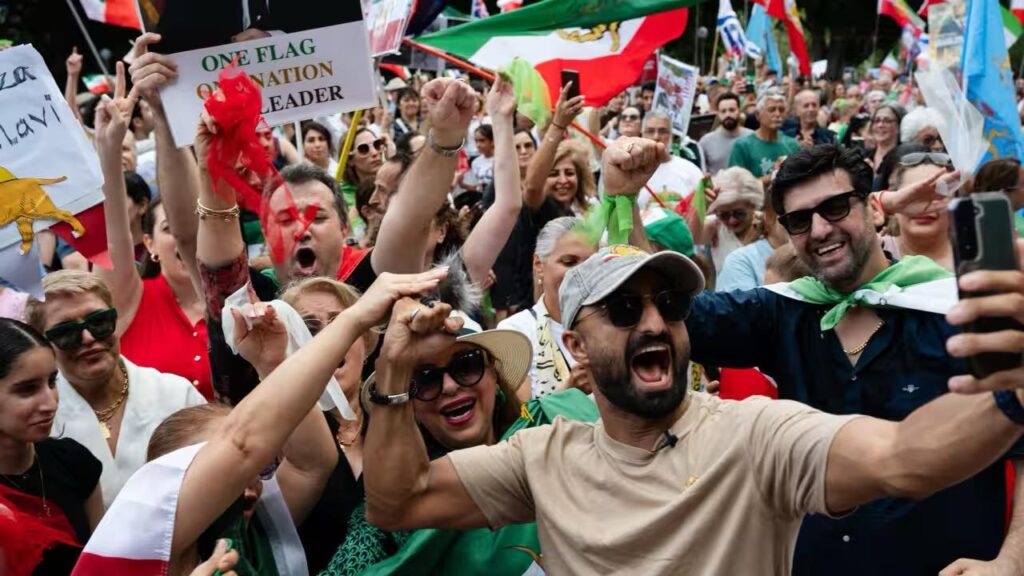
On February 28, the U.S. and Israel began a joint operation in Iran, with the goal of overthrowing the theocratic regime established in 1979 by Ruhollah Khomeini (Y. S.).
On the first day of the intervention, the Supreme Leader Ali Khamenei (Y. S.) was killed. His death was greeted with significant celebration both inside the country and across the diaspora, revealing the distance between the principles of international law and the political reality.
With few exceptions, the reactions of world leaders ranged from simple celebrations of Khamenei’s death to more nuanced recognitions of its dictatorial and theocratic rule, followed, however, by a more somber tone regarding international law and the need to comply with its norms, regardless of one’s goals.
On January 3, less than two months before the operation in Iran, the U.S. successfully carried out an operation in Venezuela, entering the country’s sovereign territory without its prior knowledge and capturing President Nicolás Maduro and the First Lady.
The reactions seen among the Venezuelan diaspora were almost unanimously happy, very much like the reactions seen in the Iranian diaspora, almost two months later. Celebrations of Maduro’s downfall took place in the United States and in a number of European cities. A significantly smaller group, constituted mostly by Americans, and not Venezuelans, protested against the operation, swiftly invoking international law and categorizing America’s actions as imperialistic.
In February 2022, Russia invaded Ukraine, sparking a war that persists without any clear end in sight.
Against the Russian aggression, many world leaders made strong—and often emotional—speeches, there were condemnatory resolutions from the General Assembly of the United Nations, and numerous sanctions promoted, mainly, by western countries. Diplomatic relations with Russia were either broken or significantly weakened and countless private companies ceased operations in Russia and some even stopped providing its services to Russian citizens, regardless of where they lived.
The American operations in Iran and in Venezuela, and the Russian invasion of Ukraine constitute blatant violations of international law, more specifically, of Article 2(4) of the UN Charter, which clearly states:
The Members shall refrain in their international relations from the threat or use of force against the territorial integrity or political independence of any state, or in any other manner inconsistent with the Purposes of the United Nations.
One final example makes the point even clearer. This curious and memorable case did not generate any significant outrage, but widespread celebrations and, in a few rather limited circles, muffled murmurs.
At 1 a.m., local time, helicopters carrying a group of U.S. Navy SEALs invaded the airspace of the sovereign country of Pakistan. As they approached a fortified compound, the helicopters landed, the SEALs entered (i.e. invaded) the building and killed, among others, the main target of the operation: Osama bin Laden (Y. S).
Approximately 7 hours later, from the East Room of the White House, a very proud Barack Obama announced the successful operation.
Merkel, then Chancellor of Germany, reacted by saying that she was “pleased that we managed to kill bin Laden”. The most interesting reaction, however, was Ban Ki-moon’s, then Secretary-General of the United Nations, who described the event as “a watershed moment” in the global fight against terrorism.
The great lord protector of international law—the Secretary-General of the United Nations—celebrated an act that clearly violated international law. The head of the organization that strives to be the central authority of the world, at least, in matters of international relations and law, celebrated an unauthorized use of force, carried out secretively and unilaterally by the United States: a clear and direct violation of Pakistan’s sovereignty.
Under well-functioning domestic legal systems, a crime is a crime. Some are considered to be more serious, thus punishable with harsher sentences, but a crime is, nonetheless, a crime. Most laws are followed most of the time. What generates frustration and rage (occasionally leading up to revolutions) is when a small minority manages to violate certain laws without facing legal consequences. In a state, such a problem can be solved through judicial reforms, for example. A state has the means to coerce its citizens to comply with the law. Citizens can be fined, arrested, and have their property seized by the state, coercing them to comply with the norms established. In the world of international relations, a violation of international law is only classified as such by states and international organizations if its consequences are undesirable and grave, at least, potentially. States do not condemn the elimination of people who threaten their own national security, not even if the act of eliminating them constitutes an infringement of international law.
Currently, all comparisons between military operations—such as the ones mentioned—, popular reactions, reactions of world leaders, and the ones of international organizations are denounced as being morally and legally relativistic (or as it is popularly referred to: whataboutism). To dismiss such arguments like so is to miss the point entirely. Understanding that the narratives that drive the perceptions of international affairs rely on double standards is fundamental to begin to comprehend the dynamics by which states operate and by which international organizations have their utility diminished, as we will see further.
International law is often taught as if the world of international relations was hierarchical. It is not. The world of international relations is anarchical. The flagrant difference in reactions—consequences in some cases, none in others—to situations that, although materially different, are equally illegal, indicates the ever so real and deep abyss between how international law perceives international relations and how international relations actually exist and operate.
What is at stake is not the old discussion regarding the status of international law (i.e. whether it is an actual area of Law, or not). What truly matters is whether or not international law is applied—if it is actually what determines, predicts, and regulates international relations—or, at least, if it is applicable. International law is evidently distant from being normative, being, in times of grave conflicts, invoked as an argument, serving to legitimize one’s position.
International law is followed with great rigor, most of the time. Most states carry out their relations with other states following the treaties, conventions, and customary law, but not due to their moral conscience. When a state acts this way (especially if it is a great power) it is because the political cost of infringing the law would be unbearable and unmanageable. What makes us question the relevance of the law are some extraordinary occasions on which it is completely ignored, without generating significant consequences for those who violated it.
At the broad level of international relations, great powers are constrained not by law, but by consequences. Where consequences are bearable, law bends. Where they are not, compliance follows. Therefore, the mechanism that coerces states to abide by international law is not universally applied and exists outside of the law itself. It is political and is not located in the sphere of influence of the law.
“At times, the costs and risks of trying to shift the balance of power are too great, forcing great powers to wait for more favorable circumstances.”, argues Mearsheimer, with “more favorable circumstances”, meaning, of course, more favorable political circumstances, since the mere passage of time does not alter the legality of an action. It alters, however, the narratives and, therefore, reactions to it.
Since these matters are more evident in the way great powers act and behave towards other great powers and towards states in more vulnerable positions, one of the most pertinent questions that can be raised is: “what does this mean to a great power like the United States?” Without a global central authority, the question, from an outsider’s point of view is not “what should the United States do?”, in terms of what actions should be taken, in accordance with the law.
The real question is “what can the United States do?”, according not to international law, but to its power, as simply put by Thucydides: “(…) the strong do what they can and the weak suffer what they must.” The reality so far examined and described is not a failure of international law, but the reality in which it exists. The true failure of international law is being detached from this world—good or bad, moral or not, but the only real one. If international law closes its eyes to reality, it renounces any ambition of being normative, being content with remaining symbolic.
Kissinger stated that “Power without legitimacy tempts tests of strength; legitimacy without power tempts empty posturing.” In order to attain its obvious goal of being normative—rising above preoccupations regarding symbolism—international law must not rest solely on the strong legitimacy it undoubtedly possesses. It must rebuild itself on the pillar of its legitimacy, while being profoundly attached to reality, recognizing it, without moral judgments, but with the clarity only realism is able to provide.
It is only through realism that international law can attain power. Without power, its legitimacy does not disintegrate. It remains and makes the acts of the institutions that guard the law empty posturing.